Seven columns, nine rows, five colours of marble packed tight. Trace neighbouring marbles of the same colour and three or more pop — diagonals count. Every marble you pop sends grey duds rising from the bottom of your opponent's board. Fill your board to the top and you drop the game. First to three wins. Alone, you can take on a three-level opponent.
| Players | 1-2 |
|---|---|
| Format | Real-time duel |
| Solo | CPU opponent (3 levels) |
| Length | 1-2 min a game · 3-6 min a match |
| Price | Free · no sign-up · no install |
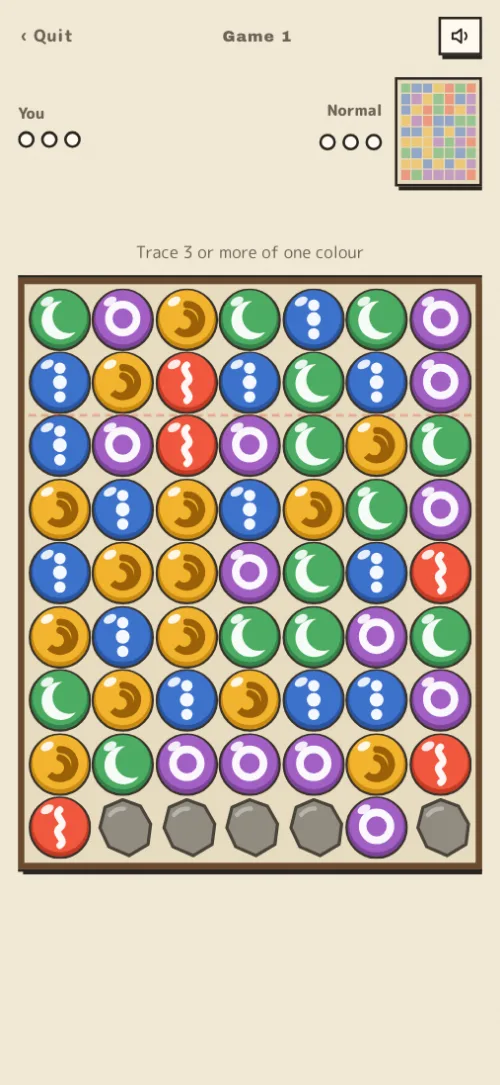
Drag across neighbouring marbles of the same colour without lifting your finger. Let go once three or more are linked and they pop. Diagonals count, and backing up one step unwinds the line.
Three sends 1 dud, five sends 3, seven sends 7, ten sends 17. Every moment you choose: pop something short to clear space low down, or hunt for the long line and attack.
Within two seconds, draw a line longer than your last and the count doubles; longer again and it triples. Repeating the same length adds nothing, so hammering out threes is not an attack. How far you keep stretching is the whole game.
Duds sent your way hover as a warning for 1.8 seconds. Pop something in that window and you cancel that many, sending the remainder back. This is where the reading happens.
Duds rise from the bottom and cannot be traced, so your playable space shrinks. Whoever reaches the top row first drops the game. First to three wins.
Two. On your own you can duel a three-level CPU. To play a friend, create a room and send them the four-letter code that appears; whoever enters the same code starts on the same board as you.
Yes. It runs in the browser on phones, tablets and computers. It is free, with no sign-up and nothing to install.
They do. A line can run in any of the eight directions. Duds, though, only crack from up, down, left and right.
Yes. Pop something during the 1.8 seconds before they land and you cancel that many; anything left over flies straight back at them.